An MOU is not a deal
Namibia made economic diplomacy the centre of its foreign policy. Signing ceremonies are not the same thing.
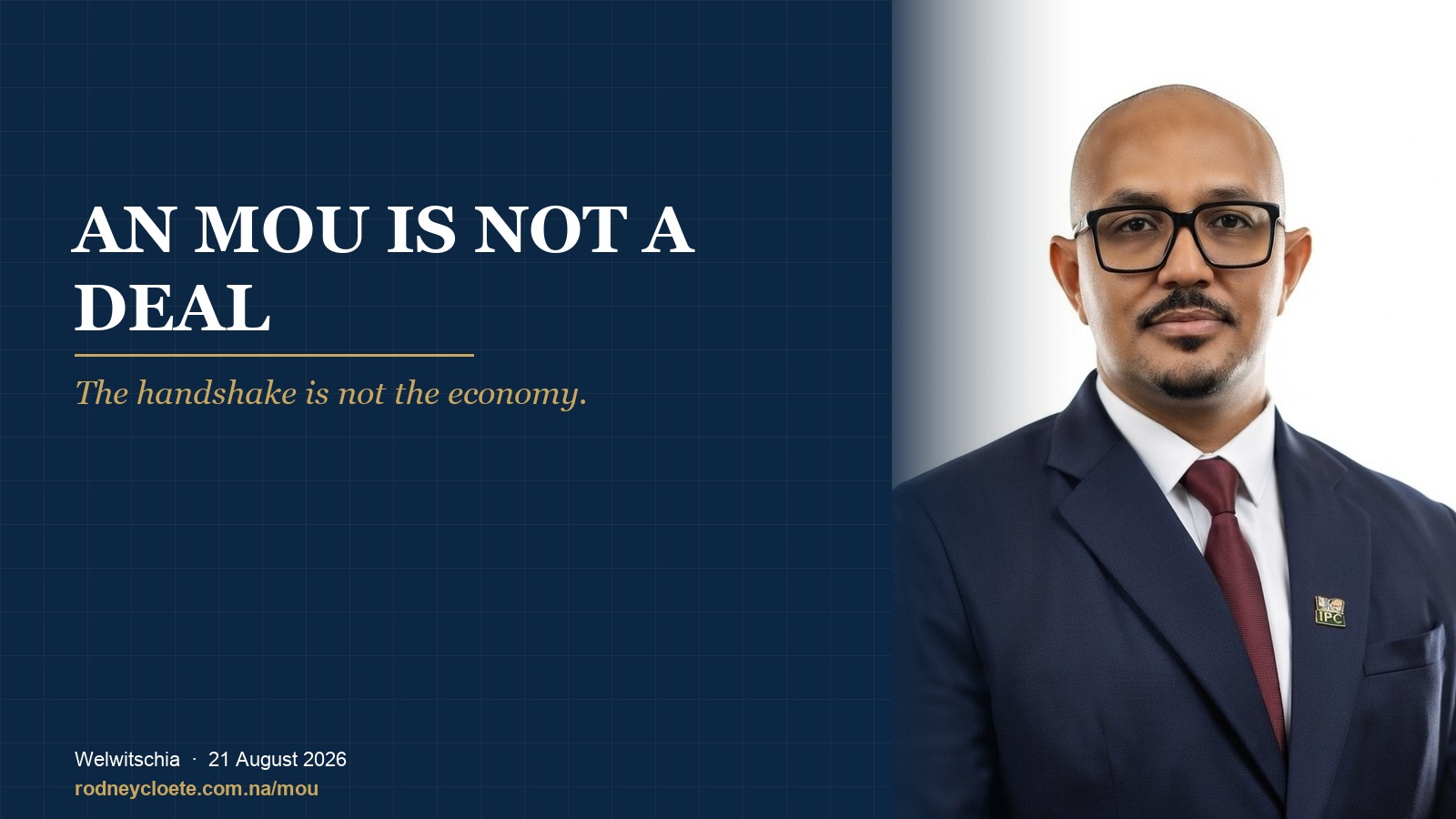
The most reliable product of Namibian diplomacy this year is a photograph.
Flags. Folders. A handshake. A Cabinet brief the next morning. Then the claim that economic diplomacy is working.
An MOU is not a deal. It is a document that usually says the parties intend to cooperate. It does not, by itself, move a container, hire a worker, or put a Namibian dollar in the fiscus. If Namibia is serious about economic diplomacy, we should stop counting ceremonies and start counting results.
What an MOU actually is
Under the 1969 Vienna Convention on the Law of Treaties, a treaty is a written international agreement between states that is governed by international law. The name on the cover does not decide the legal character. Intention does. If the parties intend to be bound, they have made a treaty. If they do not, they have made a political arrangement.
Namibia’s Constitution already knows the difference that matters at home. The President negotiates and signs international agreements under Article 32(3)(e). Cabinet assists in determining which agreements are to be concluded, under Article 40(i). The National Assembly must agree to ratification or accession under Article 63(2)(e). Binding international agreements then form part of Namibian law under Article 144.
That is a serious constitutional machine. It exists because an international commitment can change domestic rights, duties, budgets and borders.
An MOU is typically used to step around that machine. It can be approved in Cabinet, signed in public, and never laid before Parliament, because nobody is claiming it creates a legal obligation. The Legal Assistance Centre’s public treaty compilation expressly excludes non-binding instruments such as memoranda of understanding. They sit outside the record that a citizen can actually read.
That is the point, not a technicality. The instrument is chosen because it is cheap: cheap in law, cheap in scrutiny, cheap in follow-through.
Cabinet is the mill
Watch the weekly Cabinet briefs.
Cabinet does not only decide budgets, appointments and Bills. It now regularly “approves the signing” of memoranda, with Congo on political consultations and on ICT, with Spain on fisheries and on sport, with Malta on research and innovation, with China’s Ministry of Public Security on police cooperation. Each approval is announced as if a policy has been delivered.
It has not. Cabinet has authorised a signature. That is an administrative act. It is not an economic result, a ratified obligation, or an implementation plan with a named owner, a budget and a date.
This is how a non-binding document is converted into a government win. The Presidency supplies the photograph. Cabinet supplies the decision. The ministry supplies the talking point. Nobody supplies the ledger.
Talking to other governments is not bad faith. States should talk. Ministers should travel. The harder point is this: Cabinet is being used to industrialise optics. A memo that binds nobody is processed through the highest executive body in the Republic so that it can be reported as delivery.
If the instrument mattered economically, it would come with a text the public can read, an owner who can be named, a cost that can be scored, and a result that can be checked. Most of these do not.
Namibia still has no public register. These are clusters the Presidency, Cabinet and partners have themselves put on the record since March 2025: two government MOUs with India (9 July 2025); eight instruments with Botswana (10 October 2025); seven instruments with South Africa (17 July 2026), of which five were MOUs, one an air-services agreement, and one a chamber-to-chamber pact. Cabinet has also been approving further memoranda in its weekly briefs.
What the public record actually shows
I will not invent a round number. Namibia still has no public register of every agreement and memorandum this country has signed. That absence is part of the problem. What I can do is count what the Presidency, Cabinet and our partners have themselves announced since President Netumbo Nandi-Ndaitwah took office in March 2025.
On 9 July 2025, during Prime Minister Modi’s state visit (the first bilateral state visit this Presidency hosted), India’s official outcomes list recorded two government-to-government MOUs: health and medicine, and an entrepreneurship development centre. Separate announcements covered Namibia’s joining of two international initiatives and a UPI licensing track that had already been signed with the Bank of Namibia. Some coverage flattened all of that into “four MOUs”. The official Indian list did not.
On 10 October 2025, the Botswana-Namibia Bi-National Commission in Windhoek produced eight new instruments, reported as memoranda covering energy, culture, science and innovation, corrections, police, health, employment and labour, and the employment of diplomatic spouses. The President said it could never be business as usual, and that ministers must keep to timelines.
On 17 July 2026, in Pretoria, the two Presidents welcomed seven new instruments. Five were MOUs. One was a Bilateral Air Services Agreement, a real treaty-form instrument. One was an economic partnership between the two chambers of commerce, which is not a government-to-government treaty at all. Most of that package binds nobody to anything.
This week the Minister of International Relations and Trade is in Brazzaville on a visit her ministry framed around trade, energy and follow-up to the Joint Permanent Commission. Cabinet had already approved Congo instruments before the aircraft left. Whether further health or culture memoranda were signed on this trip is, as of 21 August, not on a retrieved official communiqué. That is the honest cutoff.
This is not a complete inventory. It is a pattern. High ceremony. Low paper. Almost no public text.
Pretoria already admitted the gap
The strongest evidence that these instruments stall is not an opposition talking point. It is the joint communiqué the two governments issued themselves.
Paragraph 7 of the 17 July 2026 South Africa-Namibia Bi-National Commission communiqué records that the session reviewed implementation of previous decisions “while acknowledging the need to accelerate the implementation of outstanding decisions and agreements.” The two leaders then agreed that future cooperation should focus on “measurable programmes and projects capable of generating tangible economic and developmental benefits.”
Paragraph 16 directed ministries to develop “clear implementation plans… with defined responsibilities and timeframes,” and to use the mid-term review “to assess progress, address impediments and ensure accountability.”
The true measure of our success will not be the number of agreements we sign, but the effectiveness with which we implement them.
That is President Ramaphosa, reported after the same session. Namibia does not need me to invent an implementation crisis. Pretoria put it in writing, and Windhoek signed the same page.
If last year’s instruments had been working, this year’s communiqué would not have had to order implementation plans for the new ones.
Economic diplomacy has a test. The President wrote it.
On 10 February 2026, addressing the diplomatic corps, President Nandi-Ndaitwah said economic diplomacy was no longer a complementary aspect of foreign policy but “a central instrument in advancing our national development objectives.” That, she said, was why the ministry was renamed International Relations and Trade.
She set her own test. International partnerships must translate into “tangible and measurable benefits,” including increased investment, expanded trade, skills development, technology transfer and sustainable employment.
Hold the government to that test.
An MOU is not economic diplomacy. Economic diplomacy is a bankable project, a preference that a trader can use, a border that clears faster, a skill that transfers, a job that exists. It is a treaty that has been ratified, funded and implemented. It is a concession whose terms the public can read. It is a customs procedure that has actually changed.
Paper that cannot be enforced, cannot be budgeted and cannot be scored is signalling. Signalling has a place. It is not the same as statecraft.
The Bank of Namibia’s August 2026 outlook estimated growth of 1.7 percent in 2025 and revised 2026 growth down to 2.1 percent. The IMF’s 2026 Article IV still records unemployment at 36.9 percent in the last labour-force figure it cites, and 44.4 percent among youth, and says growth remains insufficient to reduce unemployment, inequality and poverty in a meaningful way.
Memoranda did not cause those numbers. The more precise point is this: if economic diplomacy were doing what the Presidency says it is for, we would be able to show the bridge from each signature to a measurable result. The public record does not show that bridge. The ceremonies keep multiplying. The growth figure was revised down.
That is not moving the needle. That is moving the furniture for the photograph.
What would count
Five things, and none of them requires a new ideology.
First, publish the text. If Cabinet can approve an MOU, the public can read it.
Second, say whether it is intended to bind. If it is, it belongs on the ratification path. If it is not, stop announcing it as if it were a deal.
Third, name the owner, the budget and the date. Paragraph 16 of the Pretoria communiqué already asked for this. Do it in public.
Fourth, table an annual return in the National Assembly: instruments signed, instruments ratified, instruments in force, instruments with no implementation plan, and results against the President’s own list (investment, trade, skills, technology, jobs).
Fifth, stop using Cabinet as a printing press for headlines. Cabinet time is scarce. Spend it on instruments that can change a Namibian’s material conditions.
A small state cannot out-photograph larger partners. It can out-prepare them. Institutional memory is the one advantage we can actually build.
The question after every signing should be the same:
Who must do what, by when, with which money, and what will a Namibian be able to see?
Until that question has an answer, an MOU is not economic diplomacy. It is stationery.
Hon. R. O. H. Cloete, MP
Shadow Minister of International Relations and Trade
Independent Patriots for Change
Sources
Vienna Convention on the Law of Treaties, 1969 ↗ Namibian Constitution. Articles 32, 40, 63 and 144 ↗ DIRCO. Joint Communiqué, 4th SA-Namibia BNC, 17 July 2026 ↗ PMINDIA. List of Outcomes, 9 July 2025 ↗ Presidency. New Year greeting to the diplomatic corps, 10 February 2026 ↗ The Brief. Implementation and the Ramaphosa test ↗ Bank of Namibia outlook, August 2026 ↗ IMF Namibia 2026 Article IV ↗Accuracy note. This piece does not invent a complete official total of MOUs. Namibia has no public register. Clusters cited are those announced by the Presidency, Cabinet or counterpart governments and retrieved by 21 August 2026. It does not claim that memoranda caused the growth downgrade, or that any named official acted corruptly.